Tuesday, 9 August 2016

Tuesday, 12 April 2016
60 minutes of wisdom
 |
| The view from the hide at Wyver Lane |
 |
| Common Tern flew past as I arrived |
 |
| The 2 birds fed for the whole 60 minutes of my visit |
 |
| Lots of arguing Canada Geese as breeding season takes hold |
 |
| This Coot was busy nest buiding |
 |
| This Chiffchaff was almost oblivious that I was there |
 |
| At least 4 Cormorant were on the reserve |
 |
| This Wren kept appearing on the top of the stone wall |
 |
| Turns out it was collecting Moss for its nest |
 |
| Stunning Reed Bunting just outside the Hide |
Friday, 8 April 2016
Welcome to BOB, Derbyshire 'Barn Owl Box' Project
 |
| Photo by : Stuart Pike @raptorwatcher |
In 2008 I went on a FSC (Field Studies Council) Bird ringing for beginners course at Flatford Mill, I had a fantastic time and met some great people. One person that had a lasting effect on me was Steve Piotrowski, he was one of the ringing trainers. On a wet afternoon, when ringing wasn't possible, he talked about his work with the Suffolk Community Barn Owl Project and how they had brought the Barn Owl back from the brink in Suffolk. I remember thinking at the time that I would love to start a similar project in Derbyshire. I had only seen Barn Owls a couple of times and hoped for a time when they were abundant in the county and could be seen by many people, quartering over fields and marshes.
This dream was put on a back burner over the next few years as funding for such a scheme was well out of my reach. Then I joined the committee of the Chesterfield & North East Derbyshire Wildlife Trust local group. We started organising wildlife events in 2012 which enabled us to raise money to help out with some local conservation projects. After the 2014 event we had funds available for a new project and this was my chance to put forward the plight of the Barn Owl. All on the committee were instantly on board and the BOB (Barn Owl Box) project was born.
With funds to start we were up & running, Brian Goodwin (our resident craftsman) ordered the timber, roofing felt, nails etc. He stored the timber until we could find time to start building the boxes.
 |
| Brian carefully marks out the cutting lines on the outdoor ply |
In December 2015 we began building 10 boxes and also started trying to find local landowners who would let us install them on their land.
 |
| We used The Barn Owl Trust design for our boxes |
Over a period of around 3 weeks we slowly assembled the boxes, I must admit Brian did most of the work and I turned up on Tuesdays to help put the boxes together and then Brian treated the timber and felted the roofs.
 |
| The boxes were made into kits ready to assemble |
 |
| One by one boxes were glued, sealed & screwed |
 |
| This project would not have been possible without Brian's skill & the use of his workshop |
Now the boxes were made, 10 in all, it was time to get them installed ready for the 2016 breeding season & hopefully the local Barn Owls would soon be moving in. The chance to try and help a wonderful species like the Barn Owl was a very exciting prospect. I'm sure we'd make a few errors along the way, like siting boxes in the wrong place etc. Our aim is to give the Barn Owl more breeding opportunities as natural nesting sites have been lost.
I had the privilege of ringing Barn Owl chicks on The Avenue Washlands in 2014, so we decided to make that the starting point and work our way out from there. The box there had been up for 7 years before it was used so we weren't expecting the new boxes to be used straight away but we all feel optimistic that some of the boxes will be used within a few years.
 |
| Our first success with 5 Owls fledging in 2014 |
The 5 sites are a mixture of private residences & farms, all situated near Matlock, Hardwick & Clay Cross. The first box went up on Valentines day, February 14th 2016. I had been advised that 2 boxes on each site was the best way to go. Once the female had laid eggs the male would require his own roosting box as he is not allowed in the nesting box unless he was bringing in food.
It took around 3 hours to get the first box up, a combination of a big heavy box, naivety and a downfall of snow made it a tricky job!
It took around 3 hours to get the first box up, a combination of a big heavy box, naivety and a downfall of snow made it a tricky job!
 |
| Suitable sites are found & secured ladders used to attach fixings |
 |
| A securing bracket is fixed to tree |
 |
| The boxes were placed in a harness and lifted up ready for fixing |
 |
| Safety ropes and a steady nerve were required to get the boxes fixed onto the brackets |
 |
| Then hooked over the bracket to hold in place |
 |
| Screws were then used to fix the box permanently in position |
 |
| By box 4, installation times were dropping, we soon realised 2 ladders were better than 1 |
 |
| By the end boxes were being put up in around half hour |
 |
| Some great locations were found where Barn Owls were known to be in the area |
 |
| Locations were varied, like this one near Hardwick |
 |
| Great views for this land owner from his man shed if Owls moved in |
 |
| A fully installed Barn Owl Box at a Farm near Clay Cross |
The next stage is to raise another £450 for 10 more boxes and find 5 more sites for 2017. We are having another wildlife event on July 2nd this year (2016) called 'A Venue for Nature' at The Avenue Washlands Nature reserve near Chesterfield. The theme is to encourage people to invite wildlife into their gardens.
Keep an eye out for more information about this event closer to the time I would love to see you if you fancy a day full of excitement, wildlife walks and workshops.
 |
| Team BOB: Me, Ron Turner, Angela Goodwin, Brian Goodwin, Mike Backler & Geoff Ruff Also a big thank you to Lynne Allsop & Nikki Mahadevan (not in Photo) Plus of course all of the land owners |
Saturday, 26 September 2015
Ask friends & family to help Hen Harriers

Earlier today I sent this email to everyone in my address book & posted it on my Facebook page, Copy & Paste and do the same. If it generates one more signature it's worth it.
Hello Everyone.
Last February I asked you to consider signing a petition to help save one of our most wonderful birds of Prey, The Hen Harrier. The petition reached over 20,000 signatures and brought the Harriers plight to many more people. Unfortunately things haven't changed and the Hen Harrier along with lots of other wildlife are still being killed to protect grouse stocks.
5 male Hen Harriers went missing from nests earlier this year meaning that the nests failed, some think that this is not unusual but let's face it, they were killed. Males very rarely abandon females.
These killings, although not proven in all cases, are the result of persecution by Land Managers & Gamekeepers to protect Red Grouse stocks on shooting estates. Please consider signing this petition to get Driven Grouse Shooting Banned. https://petition.parliament.uk/petitions/104441
We are not asking for an outright ban on shooting, just this highly contentious and environmentally damaging type of shooting.
Read more here. http://markavery.info/epetition-ban-driven-grouse-shooting/
If after reading this you agree, please sign and pass on to friends and family.
Thanks for your Time
Stewart
Thursday, 20 August 2015
Hen Harrier Day 2015

I've started writing this blog
several times but after reading so many great blogs from other
people such as Stuart Pike, Billy Stockwell & Georgia Locock I didn't see the point in just repeating what everyone else had
already written. Yes great rallying speeches from the likes of ChrisPackham & Mark Avery, but what struck me, just like last
year, was the amazing and extraordinary voices of the people that gave up
their time to attend this years Hen Harrier Day.
 |
| Chris Packham as ever delivered a passionate & informed Speech |
 |
| Mark Avery - A modern day Wildlife Hero |
My experience was
different this year as I'd stepped in at the last minute to help
marshall the event. This gave me an opportunity to meet some top people and exchange concerns but also talk to lots of
supporters as they arrived and try and sell, sorry I mean extract a
donation for, a Hen Harrier Day wrist band. People were very generous
and they all made it clear that the money raised was going to a great
cause & were happy to donate if it was to help BAWC pay for the running of this
fantastically important event.
 |
| John and 2 of the 4 Hen Harriers that attended HH day 2 |
 |
| The passion & anger was clear from supporters |
I could hear
conversations from all around about Hen Harriers and Gamekeepers, but
this year the subjects also included the environment and the unbalanced
ecosystems that the intensively managed moors create. As Chris
Packham said in his speech, we are not yokels, we are educated and
well informed. The main difference, to me, between the two sides of
this argument are that we see the bigger picture and are concerned
about the future and sustainability. Where as the Grouse shooting
lobby are just concerned about not changing their way of life, not
removing their 'traditions' and of course not eating into their profits.
They're not worried about what they will leave for future generations to
clean up, and no thought as to whether our children and grand children
will be able enjoy sights like the wonderful Hen Harrier.
 |
| Brilliant job from Charlie Moores & team organising the event |
Since the event I've
had several chats on twitter with Country Sport fans who still deny
that Gamekeepers are partly responsible for the death of Raptors on the
Moors, even after the reports of Annie they say it could have been
any one, even that anti hunt groups would shoot her for headlines. How can the interested
parties ever work together with these attitudes still in place?
One other thing that is
obvious this year is that the general public are becoming aware of what a Hen Harrier is, still not enough yet though, and the
media are talking about it. Articles in the Telegraph and other such
like minded papers seem to be shooting themselves in the foot as
'yokels' can see straight through their pathetic attempts to fill
heads with nonsense. The RSPB is a really well respected, and
deservedly so, organisation and to attack them is very unfair.
 |
| Some one is watching from the bushes |
My hope for the next 12
months is that NGO's become a lot tougher. Mike Clarke' talk on
Saturday night was good, and his guest blog on Martin Harpers page
was a little angrier than some of the RSPB's previous statements,
but I still think that trying to negotiate with Grouse Moor owners at the present time is pointless as they seem to have no intentions of altering their ways. Unless
all stop killing birds of prey how can numbers increase? We have to
push for a ban on Driven Grouse Shooting before it's too late.
 |
| Mike Clarke - RSPB standing strong against critisism |
Jo Smith from
Derbyshire Wildlife Trust spoke with passion but we need to hear
ideas and alternatives from NGO's if they are not going to support the ban.
 |
| Jo Smith - Spoke with passion but do NGO's needto take a stronger stance? |
For me we need to get
rid of driven Grouse shooting not just for the sake of birds of prey
but all predators, they like us are just trying to live a life and
bring up families. Yes ground nesting birds will suffer losses but
who are we to determine what the population levels of wild animals
should be? Populations will go up and go down but eventually a
natural level will be found. If some species struggle or even go
extinct on the moors then that is nature at work, but land owners should not
play god and think they can do a better job.
If you didn't attend Hen Harrier Day watch highlights here.
 |
| Harry still watches over events |
 |
| Derbyshire Wildlife Trust show good support this year |
 |
| Harry is happy to see DWT at this years event |
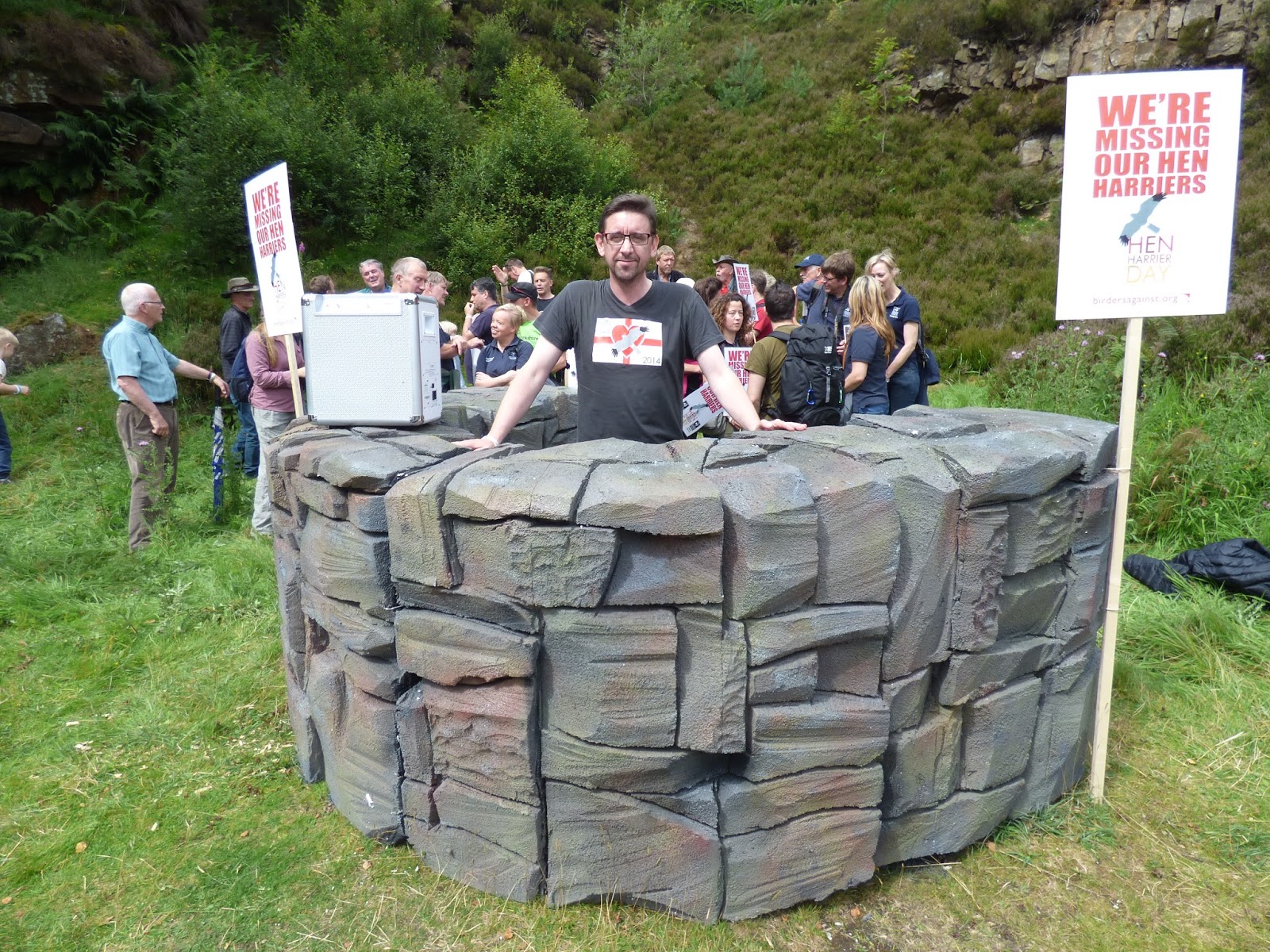 |
| Couldn't resist a chance of a picture in the BUTT |
One final note, Just before the 9th of August Tiffany Imogen posted on her website a poem about the Hen Harrier, It is a wonderfully moving poem and gave me goosebumps, please read the poem below.
Harrier
Sun creeps over thistled moor
and stains the dawn cold,
sanguine gold.
and stains the dawn cold,
sanguine gold.
A gangling hare begins
her voyage atop the heather sea,
through bilberry waves and
sphagnum froth she totters and hops,
and stops.
her voyage atop the heather sea,
through bilberry waves and
sphagnum froth she totters and hops,
and stops.
There lies a shadow on the earth.
Look up! Our hare a harrier spies,
bisecting the skies
with aureate eyes
and feathers of darkening cobalt.
bisecting the skies
with aureate eyes
and feathers of darkening cobalt.
Hare retreats; grouse awakens.
Auburn plume and crimson brow,
grouse is wanted by the world.
Auburn plume and crimson brow,
grouse is wanted by the world.
Hen harrier craves soft flesh
to nourish fragile young,
nestled low in wildling sprigs
exposed to wind and badger bite.
Portly man wants portly fowl
to shoot with steel gun;
a fattened carcass stuffed
betwixt the lips of Dionysus.
to nourish fragile young,
nestled low in wildling sprigs
exposed to wind and badger bite.
Portly man wants portly fowl
to shoot with steel gun;
a fattened carcass stuffed
betwixt the lips of Dionysus.
Ten thousand moons have
grouse and harrier flown
the heath together.
grouse and harrier flown
the heath together.
But man can find profit in Elysium;
he drains life with poison
and powder;
turns wilderness to revenue.
He has thrown our hawks into darkness.
he drains life with poison
and powder;
turns wilderness to revenue.
He has thrown our hawks into darkness.
Bright bird of Arcadia
lost upon the moor;
come back.
lost upon the moor;
come back.
Monday, 2 March 2015
2 brothers and 79 birds

I received an email from my brother suggesting that if he came over from his home in Catalan, could we do a days birding in Norfolk? It didn't take long to reply with a very excited yes. I always look forward to going out with Stephen, my skills with bird ID are ok but when it comes to Waders & Gulls I'm not as confident as we don't get a great variety in Derbyshire. He runs his own business giving guided day tours and holidays and always seems to spot things that others would miss. (see here)
Stephen arrived on the
Monday night and after some catching up and preparing sandwiches and
snacks for the day, we then went off to bed as we had agreed a 4am leaving
time so we could get to Titchwell for sun up around 7am. Our drive
was great, hardly any traffic and in 2 & ¾ hours we arrived at
the RSPB reserve. While having a quick coffee in the car park I heard
the familiar sound of Pink-footed Goose (1)
flying
towards us, we looked up and that was Stephens 1st
wish list tick sorted. He had arrived with a few birds that he really
wanted to see as he doesn't get them where he lives. Grey Partridge,
Rough-legged Buzzard, Snow Bunting & Twite along with some sea
birds such as Long-tailed Duck & Divers were targets but like me
he just enjoys being out birding and gets excited about getting great
views of any bird.
 |
| Pink-footed Geese At dawn |
As
we left the car park Blackbird
(2), Dunnock (3), Chaffinch (4) &
Moorhen (5) were
quicly added. We heard more Geese heading towards us but were
distracted by a stunning Barn
Owl (6) quartering
to our left over the reed beds, we watched it drop down several times
and all the time the geese were getting closer and closer, the a loud
BANG, BANG. Two Pink feet dropped from the sky and hit the mud, a
tosser with a gun had taken the lives of these birds for no reason as
his dog couldn't get through the mud to retrieve them, a very sad and
disturbing start to the day, what a waste of life.
 |
| You can choose your own caption for this |
The
next few bird sightings were enjoyed but we struggled to forget the
event that we had just witnessed, including Brent
Goose (7) that
was also on his wish list. As we walked on towards the beach we added
Lapwing
(8), Shoveler (9), Teal (10), Greylag Goose (11), Curlew (12), Little
Egret (13), Reed Bunting (14),
Little Grebe (15), Redshank (16) &
Black-headed Gull (17). I
took the time to check out all the Redshank in the hope of seeing a
close relative. After around 5-6 minutes I was rewarded with the
Spotted Redshank (18), White
supercilium, greyer body & more delicate bill clearly visible.
They can be tricky but I think I've got this bird nailed now, they
are certainly a lot easier in Spain when in full breeding plumage.
Next came two more birds that can be difficult to split without
experience. Godwits are obviously Godwits but getting the
Black-tailed & Bar-tailed part right takes a bit of practice. If
you get a good look at the tail then that helps enormously but when
tail is obscured then the Bar-tailed
Godwit
(19) is
a stockier bird with shorter legs & a slightly upturned bill. I
was lucky, the Bar-tailed was feeding right next to a Black-tailed
Godwit (20).
 |
| Spotted Redshank |
 |
| Stockier bird with upturned bill, Bar-tailed Godwit |
 |
| Much longer legged with straight bill, Black-tailed Godwit |
We
made camp and set up the scope on the beach in the hope of getting a
few sea birds, tucked in amongst the dunes, to shy away from the very
cold wind, we soon started adding more birds, Sanderling
(21), Dunlin (22), Turnstone (23), Grey Plover (24)
Ruff (25)
Oystercatcher (26), Common Gull (27), Herring Gull (28) &
Great Black-backed Gull (29)
were
all working the shoreline, and out to sea we spotted Great
Crested
Grebe (30), Common Scoter (31),
Goldeneye (32) &
another bird on Stephens list, the Long-tailed
Duck (33). After
around 90 minutes we started to pack up, as we were Cormorant
(34) flew
low over the choppy water & 3 Ringed
Plover (35) landed a few metres away.
Behind a small flock of birds were moving up and
down the dunes, we saw Goldfinch
(36), Linnet (37) &
we heard, then got a quick view of Twite
(38).
Moving
back down the walkway Canada
Goose (39) flew
over heading north and out on the freshwater marsh were Wigeon
(40), Mallard (41), Pintail (42), Shelduck (43), Avocet (44).
From over the far side of the reserve a male Marsh
Harrier (45) glided
low over the water putting up all the ducks & waders as it looked
for breakfast. A Snipe (45)
zig-zagged
through the reserve calling as it flew, a Pheasant
(47) called
from the reedbed and a Song
Thrush (48) sang
from the top of a willow.
 |
| Grey Plover |
 |
| Ringed Plover |
 |
| Goldfinch |
 |
| Linnet |
 |
| Shelduck |
Other
birds seen at Titchwell were Woodpigeon
(49), Magpie (50), Carrion Crow (51), Blue Tit (51), Great Tit (53),
Skylark (54), Long-tailed Tit (55), Wren (56) &
Robin (57).
We
left the reserve and as we reached the village of Titchwell we turned
right down a country lane where we had heard that large gaggles of
Pink Feet had been seen feeding over the last few days. After driving
up & down a few times there was no sign of any geese, but we did
get some great views of Grey
Partridge (58) &
Red-legged Partridge (59) in
good numbers and very close to where we had pulled up.
Then a real treat, 4 Brown Hares were chasing around in a field and as I followed them with the camera I spotted 3 sat in the hedge row, I love watching Hares and it was wonderful to see.
 |
| Grey Partridge makes a break for the cover of long grass |
 |
| Red-legged Partridge scans for Danger |
Then a real treat, 4 Brown Hares were chasing around in a field and as I followed them with the camera I spotted 3 sat in the hedge row, I love watching Hares and it was wonderful to see.
 |
| Brown Hare ran across our path |
 |
| Brown hare with black tips to the ears |
 |
| Kestrel looking for breakfast |
I was photographing it when Stephen called 'Raptors', I took a couple more shots and ran up the bank hoping for the RL Buzzard. We got incredible views of Common Buzzard (63), Marsh Harrier & 3 stunning Red Kite (64), around 10 raptors in total were soaring and chasing each other around and at one point 2 Kite clasped talons and spun earthwards for a few seconds until they released just before hitting the ground. That really got the hairs on my neck stood up, what an experience.
Looking
back over a flooded field I saw a bird that surprised me, not because
I didn't expect to see it but I was so surprised it was the first of
the day, Coot (65). On
the muddy edges there were at least 20 Ringed Plover and Stephen
pointed out 2 birds that were feeding along side, I wasn't sure at
first but then they were identified as Little
Stint (66), this
was a lifer for me so at this stage I was over the moon.
3 more birds added to the days list before we left, House Sparrow (67), Starling (68) & Jackdaw (69). No luck with the RL Buzzard but maybe we would fair better at Holkham.
 |
| Little Stint was a lifer for me |
3 more birds added to the days list before we left, House Sparrow (67), Starling (68) & Jackdaw (69). No luck with the RL Buzzard but maybe we would fair better at Holkham.
 |
| These Brent Geese few over as we walked back to the car |
The thought of visiting Holkham
beach always gets my juices flowing, not just the idea of seeing
something interesting, sea watching can always throw up a surprise,
but also because it's such a beautiful place. I always walk down to
the shoreline and do a 360, take in the vista and fill up with fresh
air.
As soon as we left the car we saw Pink Feet, Egyptian Goose, Wigeon, Little Egret, Pheasant, Curlew plus a few more species. One new bird for today was Fieldfare (70), around 15 or so was feeding with the Wigeon, I was reminded how stunning these birds are as I had great views through the scope.
As we walked towards the beach a Goldcrest (71) was added from the wood after being heard calling. A blast of very chilly wind greeted us as we left the treeline and it took a couple of minutes to find our spot and set up. Not a lot out there to start with, then Goldeneye made an appearance along with some Gulls, but after around 30 minutes Stephen called out that a pair of Red-breasted Merganser (72) were hugging the waves, he pointed the scope ahead of their flightpath and I had great views, they then landed and I had added another lifer to my list.
Time was now getting on and we had to start thinking about
light, we still hadn't seen the RL Buzzard so headed off to another
site where one had been spotted.
As we walked back on the beach we came across huge swathes of Razor Clam shells, there were thousands of them all over the sand.
As soon as we left the car we saw Pink Feet, Egyptian Goose, Wigeon, Little Egret, Pheasant, Curlew plus a few more species. One new bird for today was Fieldfare (70), around 15 or so was feeding with the Wigeon, I was reminded how stunning these birds are as I had great views through the scope.
 |
| A stunning Fieldfare |
As we walked towards the beach a Goldcrest (71) was added from the wood after being heard calling. A blast of very chilly wind greeted us as we left the treeline and it took a couple of minutes to find our spot and set up. Not a lot out there to start with, then Goldeneye made an appearance along with some Gulls, but after around 30 minutes Stephen called out that a pair of Red-breasted Merganser (72) were hugging the waves, he pointed the scope ahead of their flightpath and I had great views, they then landed and I had added another lifer to my list.
 |
| Awful picture but this Red-breasted Merganser was my 2nd lifer of the day |
 |
| Take time to enjoy the beautiful vistas at Holkham in between birds |
As we walked back on the beach we came across huge swathes of Razor Clam shells, there were thousands of them all over the sand.
 |
| Razor Clam shells |
 |
| Not a great picture but this Red Kite gave us another great tick for Holkham |
Salthouse
failed to supply the RL Buzzard which was disappointing but the day
had been so good that it didn't really matter. It did however give us
a Pied Wagtail (73) so
worth calling in.
A
quick stop at Cley and some more sea watching gave us a frustrating
distant view of a diver, as time past the views got slightly better,
enough to confirm that it was a Red-throated
Diver (74), Mick
Reavey reminded me on Twitter that '
think
Lord Snooty. Nose in the air = red (in my less than scientific
approach to dots out to sea)'.
Just
before we left we added Lesser
Black-backed Gull (75).
Very tired and starting to get
hungry (having eaten all the sandwiches) we made one last decision to
return to Titchwell to watch the sun set and maybe see the Raptor
Roost. I was surprised how many people were here, around 30 or so. 4
Marsh Harriers made an appearance and gave some good views, Rook
(76) & Collared
Dove (77) were seen
before we left and a pocket full of sunset photos were captured.
 |
| The light was great as the sun fell |
 |
| A perfect end to a fantastic days birding |
Other
birds today were Grey Heron (78), Golden Plover (79)
I
returned home shattered at around 8:20pm, whilst sat eating I
reflected on what a fantastic day we'd had, 79 species for the day,
34 added to my year list and 2 lifers, it doesn't get much better
than that. What a great place Norfolk is for any birder, whether a
beginner honing your skills or an expert looking for a rare migrant,
it will never disappoint. I had the best nights sleep I'd had for
months and yet another great memory of our wildlife to treasure.
Subscribe to:
Posts (Atom)